


How to Spot a Fake IPTV Service: 5 Red Flags Every Canadian Should Know in 2026
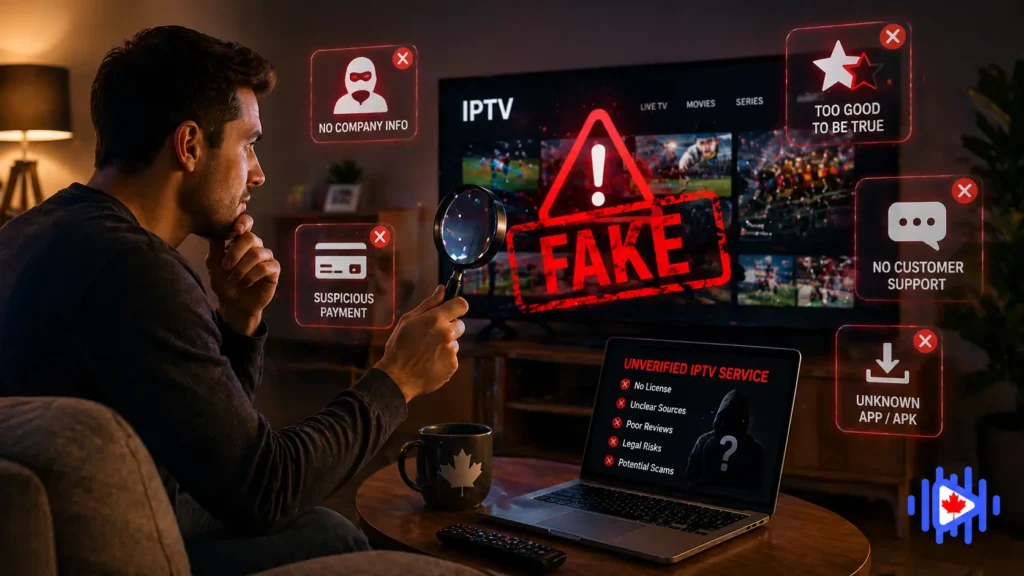
The IPTV service market in Canada is larger than it has ever been, which means there are more fake services running in it than ever before. Some of them are obvious. Others are surprisingly convincing until they take your money and disappear. Here is what to look for before you hand over a dollar.
Why This Is Worth Your Attention in 2026
Canada’s cord-cutting wave has brought a serious problem with it. As more people search for an IPTV service to replace their cable subscription, more scammers have positioned themselves to intercept that search. The volume of fake, fly-by-night, and deliberately deceptive IPTV service operations in the Canadian market has grown alongside the legitimate ones, and the fakes have gotten better at impersonating the real thing.
The typical scenario goes like this. Someone finds a provider through a Google search or a Facebook group recommendation. The pricing looks great, maybe $8 a month. The channel count sounds impressive, 15,000 channels listed on the site. They pay for a year upfront to get the best rate. For the first week or two, everything seems fine. Then the channels start dropping. Customer support stops responding. Three months in, the service is borderline unusable. By month six, the website is gone.
This is not an edge case. It is the most common complaint pattern in Canadian IPTV service communities, and it happens because subscribers did not know what to look for before paying. The red flags I am covering here are not subtle. They are patterns that show up consistently across fake services, and once you know them, spotting a bad provider takes about five minutes of evaluation.
If you are still figuring out what IPTV is and how legitimate services work before diving into the scam-spotting specifics, the complete IPTV guide for 2026 gives you the context that makes these red flags easier to recognize.
Fake IPTV services are not technically inferior accidents. Most of them are deliberate operations designed to collect subscription fees before the inevitable collapse. The economics are perversely straightforward: collect 12-month subscriptions from as many people as possible, run the service minimally for a few months, then disappear. Understanding this helps you recognize the warning signs for what they are.
This one should be the easiest to spot and somehow it still catches people. When you see an IPTV service advertising at $3 a month, or $25 a year, or whatever variation of “impossibly cheap” they are running that week, the question is not whether the price is good. It is whether the price makes any sense given what a functioning service actually costs to run.
Running a real IPTV service at scale requires serious server infrastructure. Canadian channel feeds require ongoing licensing or at least ongoing acquisition of those feeds. A CDN capable of delivering 1080p and 4K streams to thousands of simultaneous users without constant crashes is expensive. Anti-DDoS protection, which any public-facing streaming service needs, adds to that cost. Legitimate providers who maintain actual quality infrastructure have a cost floor somewhere between $8 and $15 CAD per month per subscriber on annual plans. Below that floor, the math does not work unless corners are being cut somewhere you will feel later.
The cut corners on cheap services follow a predictable pattern. Overloaded shared servers that work passably on a quiet Tuesday afternoon and collapse completely during Hockey Night in Canada when tens of thousands of subscribers are hitting the same streams simultaneously. Channels that disappear without notice because the provider stopped paying for whatever source they were pulling them from. Degraded stream quality during the periods when you most want to watch. None of this is obvious when you are looking at a $25-per-year price tag on a landing page.
To understand what fair IPTV service pricing in Canada actually looks like in 2026 and what different price tiers realistically deliver, the monthly vs. yearly IPTV Canada comparison breaks down the economics clearly.
Every legitimate IPTV service in Canada offers some form of trial or testing period before you commit to a subscription. This is not charity. It is confidence. A provider who knows their service delivers good quality on Canadian ISPs during peak hours has no reason to hide that from potential subscribers. A trial is their sales pitch playing out in real time on your actual setup.
A provider who refuses to offer any trial, who deflects the request with “we don’t do that,” or who offers a “trial” that requires full payment upfront and is non-refundable, is telling you something about what they think would happen if you tested their service before paying. Think about that for a moment. The most likely explanation for not offering a trial is that the service does not hold up well under evaluation.
The refund policy angle is slightly different but equally telling. Legitimate IPTV service providers typically offer some form of refund within a reasonable window if the service genuinely does not work on your connection. They can afford to do this because most subscribers who test and find it working stay. Fake services often have elaborate-sounding refund policies that require filing tickets, waiting periods, and “technical verification” that conveniently never resolves in your favor.
Here is a claim you will see on virtually every fake IPTV service landing page: “20,000+ channels.” Sometimes it is 30,000. Sometimes it is 50,000. I have genuinely seen “100,000 channels” on a provider’s homepage. The number means nothing. Absolutely nothing. What matters is not how many channels exist in the playlist but whether the specific channels you actually watch deliver consistently at acceptable quality during the times you actually watch them.
Fake services inflate channel counts by including thousands of dead streams, duplicate quality tiers they have not actually maintained, channels from every country on earth regardless of stream quality, and PPV and event channels that aired once years ago and are still in the playlist as dead entries. A provider with 3,000 actively maintained, reliable channels in the Canadian market is worth more than one with 50,000 channels where the TSN feed drops during every Leafs game.
The questions that actually reveal quality are specific: Do you carry TSN 1 through 5? Sportsnet East, West, Ontario, Pacific, and 360? RDS and TVA Sports for Quebec subscribers? Do those channels maintain HD quality during NHL playoff games, not just at 2 PM on a Tuesday? Can you show me uptime statistics? Do you have a status page or community where current subscribers report issues? Fake providers dodge these questions or give vague assurances. Legitimate providers answer them directly because their service actually delivers.
Payment method is not just a convenience question. It tells you something concrete about how much accountability the provider is willing to accept. A provider who only accepts Bitcoin, USDT, prepaid Visa gift cards, or similarly untraceable payment methods has made a deliberate decision to operate without financial accountability. There is exactly one reason to structure payments this way: it makes chargebacks and refund disputes impossible.
This does not mean every crypto-accepting provider is a scam. Some legitimate providers have added crypto as an additional payment option alongside traditional methods. The problem is when crypto or gift cards are the only options available, which signals an operation that expects disputes and has pre-emptively made them impossible to win. Compare this to legitimate Canadian IPTV service providers who accept Interac e-Transfer, credit cards through recognized processors, and PayPal, all of which come with chargeback and dispute mechanisms that give you recourse if something goes wrong.
Related to this: providers who quote prices in USD when targeting Canadian subscribers are adding a hidden cost. At current exchange rates, a “$9.99 USD/month” service is actually closer to $14 CAD. Legitimate providers serving the Canadian market quote in CAD and offer Interac e-Transfer as a native payment method. Seeing USD-only pricing from a service claiming to specialize in Canadian content is a mismatch worth noting.
This one tends to be invisible during the evaluation phase because fake services often have responsive pre-sale support. They want your money and will answer questions quickly to get it. The test is what happens after you pay, specifically when something goes wrong.
The pattern with fake IPTV services is consistent: pre-sale inquiry gets answered within hours, sometimes minutes. Post-payment setup questions get answered, though maybe a bit slower. First actual technical issue, the response time extends to days. By the second or third real problem, responses stop arriving entirely. The support ticket system becomes a black hole. The live chat shows “agents available” but nobody ever responds. The WhatsApp number goes to voicemail. By this point, you have typically already paid for multiple months or an entire year.
Legitimate IPTV providers have support infrastructure that scales with their subscriber base because they intend to have that subscriber base over a long period. They have support systems because they know issues will occur, and managing them well is how they keep subscribers renewing rather than churning. An easy test before subscribing: send a pre-sale technical question through their support channel at 9 PM on a Friday and note the response time and quality. That tells you more about the support experience than any number of positive reviews they may have solicited.
Fake vs. Legitimate IPTV Service: At a Glance
The differences between a fake and a legitimate IPTV service become clear when you put them side by side. Here is what those differences look like across the factors that matter.
| Feature | Fake IPTV Service | Legitimate IPTV Service |
|---|---|---|
| Pricing | Under $5/mo, suspiciously cheap | $8 to $15 CAD/mo on annual |
| Free trial | None, or requires full payment | Free, no card required |
| Payment methods | Crypto only, gift cards, USD only | Interac, credit card, PayPal |
| Channel focus | “50,000 channels” no specifics | Specific named Canadian channels |
| Support | Fast pre-sale, disappears after | Consistent, post-sale responsive |
| Peak-hour performance | Degrades during sports events | Stable during NHL playoffs |
| Service lifespan | Disappears within 6 to 12 months | Multi-year operational history |
| Refund policy | Non-existent or unenforceable | Clear, honored in practice |
According to reporting by Consumer Reports on streaming service scams, the subscription trap pattern, where services collect annual fees and degrade or disappear within months, has become one of the fastest-growing categories of online subscription fraud affecting North American consumers. IPTV service is not uniquely targeted, but the anonymous nature of many IPTV providers makes the category particularly susceptible to this pattern.
What to Actually Do Before You Subscribe to Any IPTV Service
Knowing the red flags is useful. Having a concrete evaluation process is more useful. Here is what the evaluation should look like before any money moves.
Step 1: Find the provider’s operational history
Search the provider’s domain name in a WHOIS lookup. Check when it was registered. A domain registered six months ago with no verifiable history is a real risk. Look for the provider’s name in IPTV community forums on Reddit (r/IPTV and r/IPTVReviews are the most active Canadian communities) and check whether the discussion is recent and substantive or consists of obvious promotional posts. A five-year-old domain with a thread history of technical support discussions is a much better signal than a two-month-old site with 47 identical five-star reviews.
Step 2: Request a trial specifically for your setup
Do not just ask “do you have a trial.” Ask for a trial that covers the specific channels and quality you need during a peak-hour test. Watch a sports channel for 30 minutes at 8 PM on a Bell or Rogers connection. If that does not hold quality, you have your answer before paying anything. The IPTV free trial guide for Canada explains how to structure this test to verify what you need rather than what the provider wants to show you.
Step 3: Verify the specific Canadian channels they carry
Ask directly about the channels you watch. “Do you carry TSN 1 through 5 in HD?” “Does RDS include TVA Sports?” “Are SportsNet regional feeds included or just the main channel?” A legitimate provider either answers specifically or tells you to test during the trial to verify. A fake provider says “yes we have everything” without specifics. The best IPTV Canada providers tested and compared for 2026 includes channel coverage verification as a primary test criterion, which is the right approach.
Step 4: Test customer support responsiveness
Send a technical question through their support channel at an inconvenient time, specifically evening or weekend. Note not just the response time but the quality of the response. A provider who gives you a specific, technically accurate answer to a setup question at 10 PM on a Saturday is running real support infrastructure. A provider who sends an automated reply and never follows up is probably running support the same way they run their service.
Step 5: Start with monthly before committing to annual
This one costs a bit more in the short term but protects you from the most common fake IPTV scenario. A provider that looks good for 30 days is far less likely to be a fly-by-night operation than one that looked good for one trial week. Upgrade to annual only after you have confirmed the service maintains quality over a real-world month that includes at least two or three live sports events during peak hours.
Legitimate IPTV services offer free trials, accept Interac, answer specific questions about specific channels, have verifiable operational history, and maintain quality during NHL playoffs. Fake ones avoid trials, accept only crypto or gift cards, talk about 50,000 channels without specifics, have thin history, and collapse during the exact events you subscribed for. The guide on IPTV legality in Canada for 2026 also covers the regulatory context that explains why some providers operate with more accountability than others.
What legitimate IPTV actually delivers
It is worth spending a moment on this because the scam discussion can make the whole category feel risky. It is not. There are legitimate IPTV services in Canada with multi-year operational histories, verifiable infrastructure, and thousands of subscribers who renew annually because the service actually works. Getting the good experience requires the evaluation steps above, but the good experience is genuinely available. The IPTV Canada benefits overview covers what you should expect from a service doing the job properly, which gives you a useful baseline for comparison when evaluating any provider. And for a safe path to subscribing without the evaluation anxiety, the guide on how to get the best IPTV Canada subscription easily walks through the safest approach step by step. Understanding the hardware side of IPTV boxes also helps, since some fake providers push overpriced or unnecessary hardware purchases alongside their subscriptions as an additional revenue stream.
The IPTV market in Canada is not inherently a minefield. It just requires about twenty minutes of evaluation that most people skip because the pricing looks good and the sales pitch sounds right. The providers designed to take your money have optimized their landing pages for exactly that response. The five red flags in this guide exist specifically to interrupt that process with questions that separate the operators who can actually deliver from the ones who cannot.
Take the trial, test it on a hockey night, verify the channels you care about, and check the payment method. That is genuinely most of the work. After that, you are choosing between legitimate options rather than between legitimate and fake, which is a much better problem to have.
